

Power for Food Partnership at GFFA 2026
Water is fundamental to agriculture, yet access to energy and irrigation remains severely limited for smallholder farmers across Africa. While smallholders produce around 80% of the region's food, most still lack access to electricity, and approximately 4% of Africa's farmland is currently irrigated. These constraints limit productivity, resilience, and food security at scale. Decentralised renewable energy, particularly solar-powered irrigation, offers a clear pathway to overcome these barriers, but unlocking its full potential depends on cross-sector collaboration that links water, energy, agriculture, and nutrition.
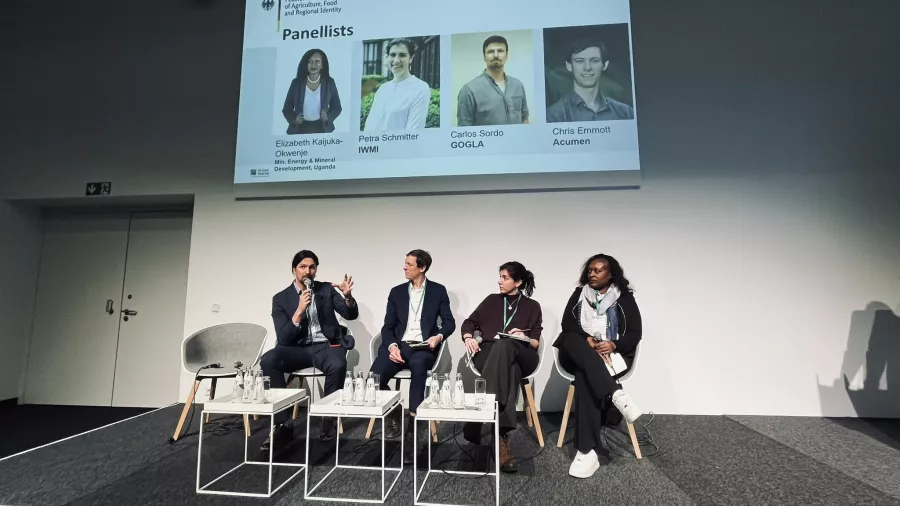
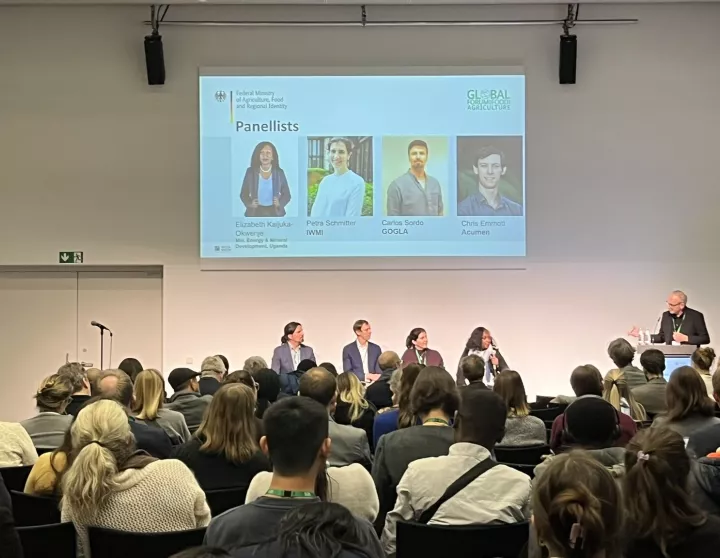
At the 18th Global Forum for Food and Agriculture (GFFA), held under the overarching theme "Water. Harvests. Our Future.", the Power for Food Partnership and the Agri-Energy Coalition co-hosted a session exploring how decentralised renewable energy and integrated agri-energy solutions can boost productivity, improve diets, protect ecosystems, and scale responsibly within ecological limits. Moderated by Lawrence Haddad CMG of the Global Alliance for Improved Nutrition (GAIN), the panel brought together experts and practitioners from Wageningen University & Research, GOGLA, the International Water Management Institute (IWMI), Acumen, the Government of Uganda, and GIZ. Bas Hetterscheid, Wageningen University & Research set the scene by summarising the issue at hand with one simple example:
"The worst time to irrigate is when the sun shines."
Bas Hetterscheid, Wageningen University & Research
The panel discussion moved quickly from the underlying issues to the conditions needed for change. The conversation centred on three recurring themes: markets and affordability, the role of finance, and the importance of policy alignment. On markets, the message was direct: solutions only last if they are economically viable without permanent subsidy. On finance, the panel emphasised the importance of deploying public funding strategically to build markets that can sustain themselves. And from a policy perspective, speakers underlined that governments across East Africa are already beginning to integrate nexus thinking into national priorities.
"Do not focus on grants and subsidies, focus on your core business. If energy isn't affordable, food isn't affordable."
Carlos Sordo, GOGLA
"It's key we use public finance to build long-term sustainable markets."
Christopher Emmott, Acumen
"These new nexuses are a new way of thinking."
Elizabeth Kaijuka Okwenje, Government of Uganda
Closing the discussion, Barbara Richard of GIZ brought the focus firmly back to action: "It's not about adding complexity, it's about managing complexity more intelligently." The conclusion was shared across all perspectives in the room: nexus thinking is not a theoretical framework. It is a practical way of working: aligning sector goals, finance, policy, and markets to reduce risks and unlock value chains for farmers and communities across East Africa. As Lawrence Haddad reflected at the close:
"I was really impressed by this group, this collaboration between these four entities."
Lawrence Haddad, CMG of the Global Alliance for Improved Nutrition (GAIN)
Follow the Power for Food Partnership and the Agri-Energy Coalition on LinkedIn for more events and updates.